Hello, fellow TypeScript developers! Today, let’s explore another powerful feature in TypeScript’s arsenal: Partial<Type>. It’s a game-changer for efficiently handling data updates, especially in RESTful API interactions.
🔧 Understanding Partial<Type>:
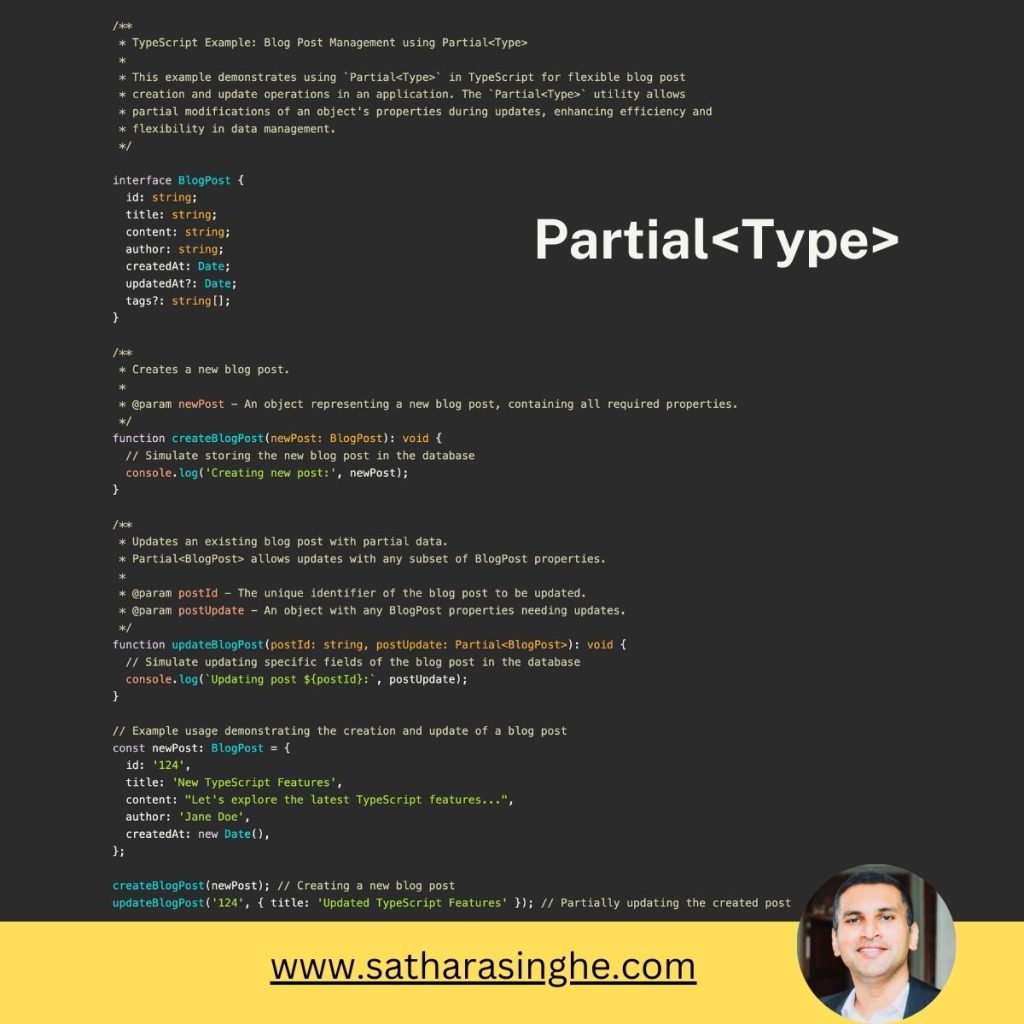
Partial<Type> in TypeScript is a utility that enables us to create a version of an existing type with all its properties set to optional. This is incredibly useful for update operations where you don’t need to provide all the details of an object.
🌍 Real-World Application: Blog Post Management
Imagine a scenario in a web application where you handle blog posts. Creating a post requires full details, but updating one should be flexible, allowing changes to just a few fields.
🛠️ Our Approach:
We use Partial<Type> to define the update operation for blog posts. This allows us to pass only the fields that need updating, making the API more flexible and user-friendly.
🔗 Explore the Example on GitHub:
For a hands-on look, check out the implementation on my GitHub:
💡Why It’s a Big Deal:
Using Partial<Type> not only simplifies our code but also enhances its resilience. It elegantly handles partial updates, ensuring our application can adapt to varying data needs without compromising type safety.
👨💻 Pro Tip: Plan for Change
Always design your data handling strategies to be adaptable. Partial<Type> is a testament to how TypeScript helps us build applications ready for change and growth.
🤔 Have you used Partial<Type> in your TypeScript projects? How did it transform your data management strategies? Let’s discuss and learn from each other’s experiences!
#TypeScript #JavaScript #WebDevelopment #APIs #CodingTips #SoftwareEngineering #DataManagement #PartialType #platform
Leave a Reply