Have you ever faced situations where you need to handle data whose structure you can’t entirely trust? Perhaps it’s a configuration file that can be manually edited, or maybe it’s a third-party API with inconsistent responses.
🔍 Enter TypeScript’s unknown Type
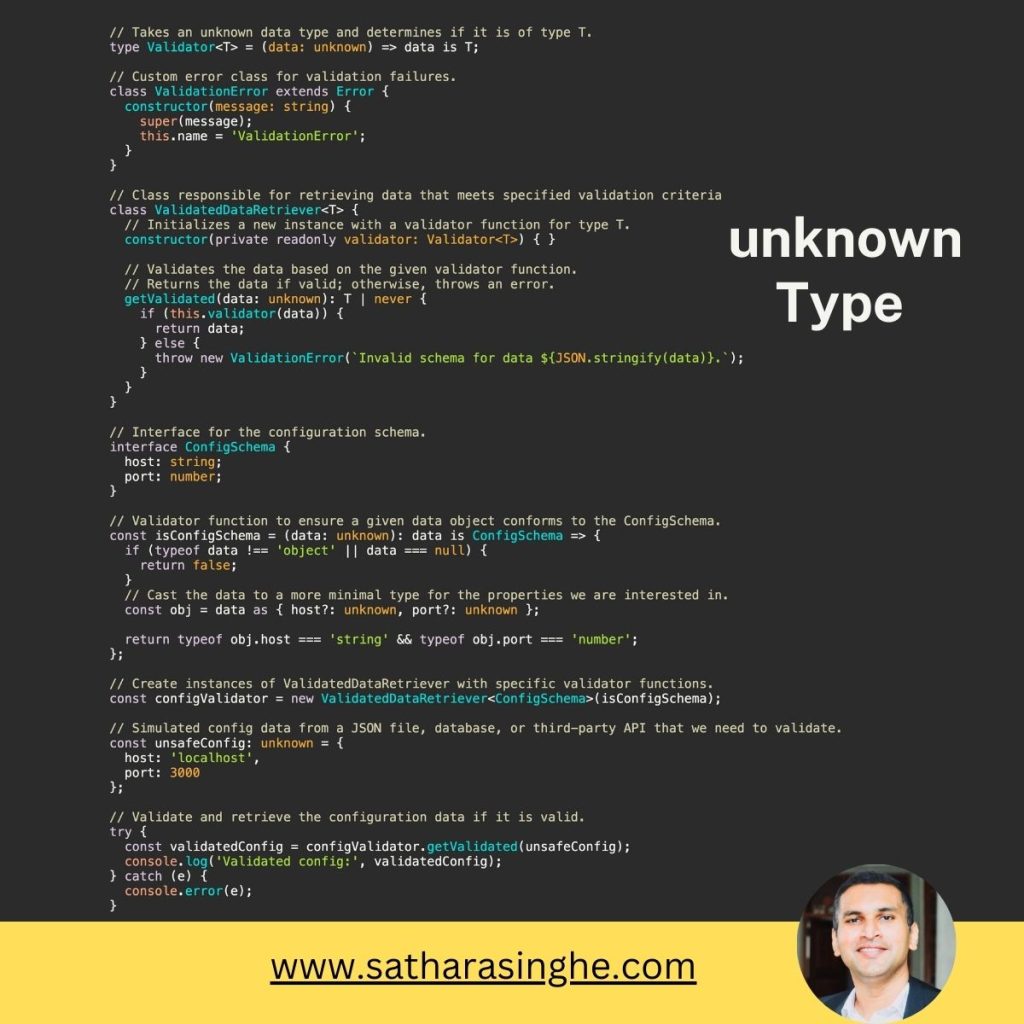
The unknown type is one of TypeScript’s built-in types that allow you to handle variables in a type-safe manner without knowing their exact structure. Unlike the any type, variables of type unknown force you to perform proper type-checking before you operate on them. This ensures robustness and type safety in your code.
👩💻 Real-world Application
Consider a server application that relies on a configuration file. The file is supposed to follow a particular schema, but since it can be manually edited, we can’t fully trust it. Using the unknown type coupled with custom type guards can ensure that the config adheres to the expected shape before your application uses it.
✅ Why Use `unknown` Over `any`
- Encourages Type Safety
- Forces Proper Validation
- Makes Code Self-Documenting
📚 Conclusion
TypeScript’s unknown type is a powerful tool for enforcing type safety when dealing with uncertain data structures. It empowers developers to write more robust, error-resistant code, reducing runtime errors and making applications more secure.
🚀 Share Your Experiences
Have you ever used TypeScript’s unknown type and custom type guards to validate uncertain data structures? Or maybe you’ve developed your own utility classes for robust data validation? I’d love to hear about your experiences and the approaches you’ve taken! 💬
#TypeScript #JavaScript #TypeSafety #BestPractices #Programming #SoftwareEngineering
Leave a Reply