Hello, TypeScript enthusiasts! Today, I’m excited to talk about one of TypeScript’s most powerful features: Generic Constraints. They are a game-changer for writing flexible, reusable, and type-safe code. Let’s delve into why they’re so important and how they can be used in real-world scenarios.
🔑 What Are Generic Constraints?
Generic constraints in TypeScript allow us to write functions, interfaces and classes that can work with a variety of types while still enforcing certain criteria. This means we can create highly reusable and adaptable code without sacrificing type safety.
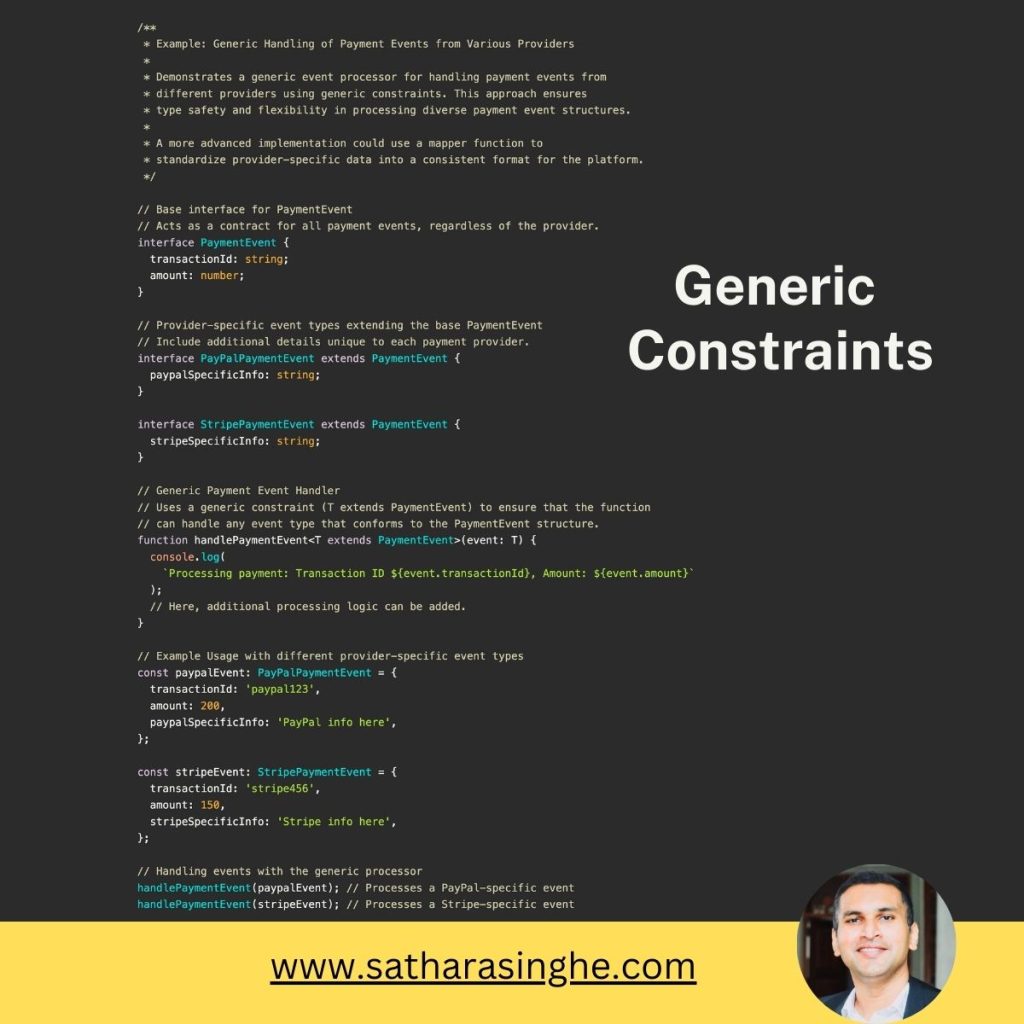
🌍 Real-World Application: Unified Payment Event Processing
Imagine a platform that integrates with various payment providers like PayPal and Stripe. Each provider sends payment events, but the structure of these events might differ slightly from one provider to another. How do we handle these events in a unified, type-safe manner? This is where generic constraints shine!
🚀 Our Approach
We’ve developed a generic event processor that can handle payment events from any provider, ensuring each event adheres to a base PaymentEvent structure. This approach allows for flexibility in handling events from different sources while maintaining the integrity and uniformity of our event processing logic.
👨💻 Pro Tip: Level Up with Mappers
Want to take it a step further? Integrate mapper functions to transform provider-specific event data into a standard format for your platform. This not only simplifies your event processing logic but also makes your code more resilient to changes from external providers.
🤔 Why Does It Matter?
Generic constraints are not just a technicality; they encourage us to think about the relationships between different parts of our code. By using them, we can build applications that are more robust, easier to maintain, and ready to scale.
💬 Have you used generic constraints in your TypeScript projects? What problems did they help you solve? I’d love to hear your experiences and insights!
#TypeScript #JavaScript #Node #CodeFlexibility #WebDevelopment #SoftwareEngineering #TypeSafety #GenericConstraints #platform
Leave a Reply