Hello TypeScript enthusiasts! This week, we’re exploring the Exclude utility type, a powerful feature for fine-tuning type handling in event-driven applications.
🔧 Understanding Exclude:
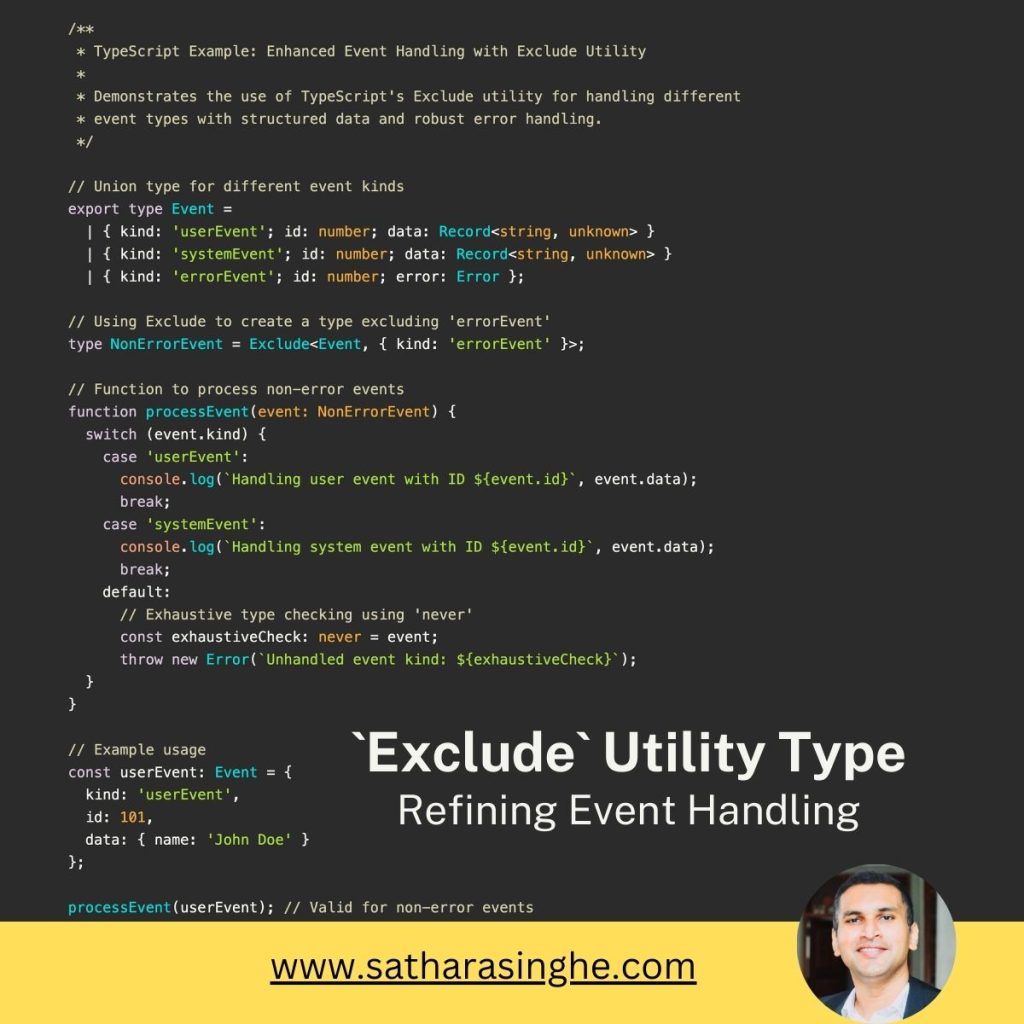
Exclude in TypeScript allows us to create subtypes by excluding specific members from a union type. It’s a fantastic tool for conditional type manipulation, making our code more precise and easier to maintain.
🌍 Practical Use Case: Event Processing:
In systems handling diverse events, Exclude helps us filter out specific event types, such as error events, ensuring they’re processed differently. It’s especially useful in back-end services where different event types require unique handling strategies.
🛠️ Our Approach:
Using Exclude, we create a subtype of events that excludes error-related ones. This allows us to implement targeted logic for regular events while separately handling error events, enhancing the robustness of our event processing logic.
🔗 Explore the Example on GitHub:
Dive into a detailed implementation of event processing using Exclude on my GitHub:
👨💻 Pro Tip:
Leverage Exclude for cleaner switch-case structures and to avoid inadvertently missing event types. It’s an excellent way to enforce exhaustive handling in complex systems.
🤔 Your Thoughts:
How have you used Exclude or other utility types in your TypeScript projects? Share your experiences and let’s learn together!
#TypeScript #JavaScript #ExcludeUtility #EventHandling #BackendDevelopment #TypeSafety #CodingBestPractices #SoftwareEngineering #PlatformDevelopment
Leave a Reply