Hello TypeScript community! This week, we’re diving into a nifty TypeScript feature – the never type, and how it ensures you never miss handling an API response.
🔧 The Role of never in TypeScript:
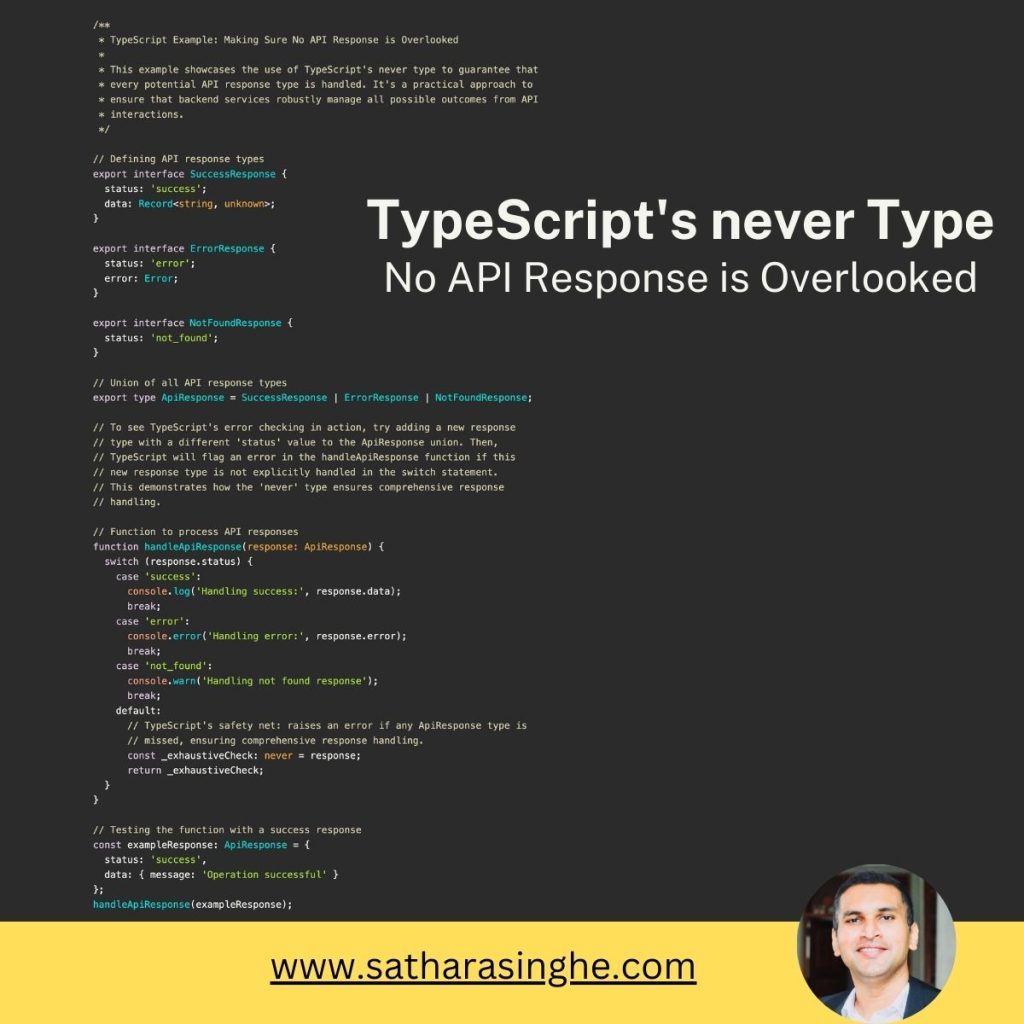
never in TypeScript is a bit like a safety net. It’s used in scenarios where you should never end up. When applied in API response handling, it ensures every possible response is accounted for.
🌍 Practical Use Case: API Response Handling:
In backend development, handling different types of API responses is a daily task. But how do you make sure you’ve covered every possible response? That’s where never comes into play.
💡 Our Approach:
We use the never type in a switch-case structure when processing API responses. If we add a new response type and forget to handle it, TypeScript will let us know. It’s like having an extra pair of eyes on your code!
🔗 Explore the Example on GitHub:
Check out a real-world example on my GitHub, where we use never for exhaustive API response handling:
👨💻 Pro Tip: Error-Proof Your Code:
Using never is a simple yet effective way to bulletproof your switch-case statements. It’s especially handy in large-scale projects where keeping track of all possible cases can be daunting.
🤔 Ever Caught by a Missed Case?:
Share your experiences with handling exhaustive cases in TypeScript. Have you used never to catch those sneaky unhandled cases? Let’s discuss!
#TypeScript #JavaScript #neverType #APIs #BackendDevelopment #CodingBestPractices #platform
Leave a Reply