Hello, TypeScript enthusiasts! Let’s explore Union Types, an essential feature that greatly simplifies handling various data types.
🔧 Demystifying Union Types:
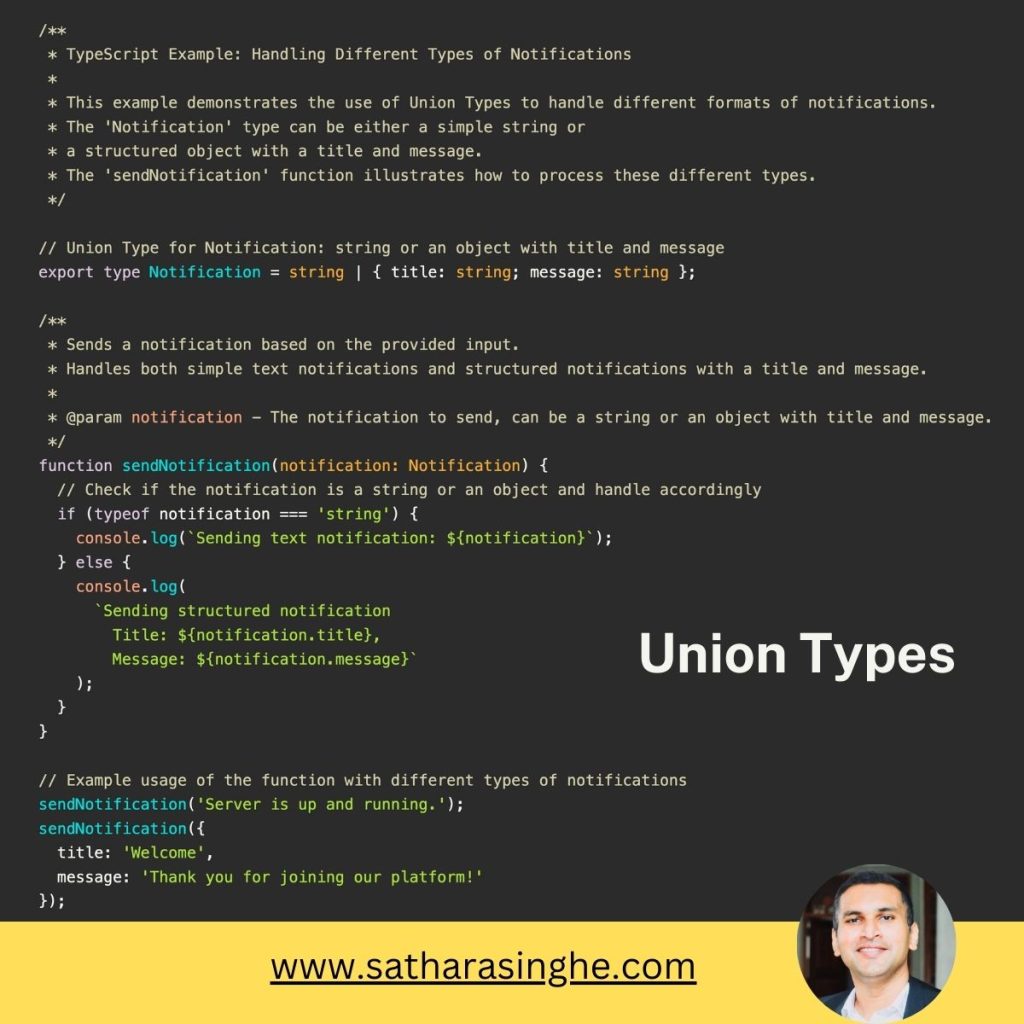
Union Types, marked by the vertical bar (|), allow a single variable to represent multiple types. This capability is vital for functions that interact with different kinds of data, enhancing both versatility and type safety.
🌍 Real-World Use Case: Notification System
Consider handling notifications in a backend application. With Union Types, a single function can efficiently process notifications, whether they’re simple text messages or structured objects with detailed information.
🔗 Explore the Example on GitHub:
Check out my GitHub for a hands-on example of Union Types in our notification handling scenario:
💡 Why They’re Essential:
Union Types offer a straightforward way to deal with diverse data types, maintaining TypeScript’s robust type safety while keeping our code flexible and clean by reducing the need for complex conditional logic and multiple function variations.
👨💻 Pro Tip: Union Types for Clarity
Use Union Types for clear, concise code. They’re ideal for variables or parameters that can have a few different types. This simplicity enhances readability and eases maintenance.
🤔 Let’s Discuss Union Types
As you embark on your TypeScript journey, how do you envision Union Types enhancing your projects? Any scenarios where they could be particularly useful? Let’s discuss!
#TypeScript #JavaScript #UnionTypes #WebDevelopment #DynamicData #SoftwareEngineering #CodingFlexibility #platform #backend
Leave a Reply